

The Role of Construction Clients in Shaping a Sustainable Built Environment
Select a country
Real estate transformation is crucial for achieving climate goals and social equity

The built environment shapes and affects daily life, as it forms the settings in which we live, work, and have social interactions. At the same time, the built environment plays a pivotal role in global sustainability efforts as its embodied and operational emissions account for a significant share of greenhouse gas emissions globally. Moreover, the construction sector is marked by high resource use and is a major source of waste.
Meeting the goals of the Paris Agreement requires a rapid transition toward a low-carbon, climate-resilient and nature-positive built environment. But environmental sustainability alone is not enough. To build truly liveable, inclusive, and just environments, it is equally important to ensure equitable access to housing, uphold fair working conditions, and enable long-term affordability and social value for residents.
In the EU, buildings account for

>30%
of the EU environmental footprint

1/3
of the EU material consumption

42%
of the EU total energy consumption

35%
of the EU greenhouse gas emissions

7%
of the EU total employment
Construction clients can drive the transformation

Ranging from private developers to housing associations, public authorities and institutional investors, construction clients play a pivotal role in driving the transformation of the built environment.
They commission new structures as well as the renovation of existing buildings, including residential houses, commercial developments and public buildings. As those who contract, finance, and set the terms of construction projects, their decisions have far-reaching impacts: not only on carbon emissions and resource use, but also on urban equity, housing quality, and labour conditions across the construction supply chain.
What this platform does

This platform explores the often-underestimated influence of construction clients and evaluates their standards, climate goals and social responsibility. It focuses on ten European countries — the Czech Republic, Denmark, France, Germany, Ireland, Italy, the Netherlands, Poland, Spain, and the United Kingdom — for which leading construction clients are profiled and assessed in relation to their policies.
Moreover, an overview of the regulatory environment at the EU and country level is given, with a focus on accountability, transparency, and sustainability requirements that shape the space in which construction clients operate. Together, these analyses clarify to what extent the leading construction clients in the ten focus countries take responsibility for a sustainable transformation of the built environment.

Featured
Construction clients commission new construction and renovation projects
Construction projects can be subdivided into new buildings versus renovation and repurposing projects. Many European countries have identified the construction of new housing as a key government priority, considering widespread shortfalls in available housing, particularly of affordable and social homes.
Investments in renovation also play a significant role in the market in recent years. This trend is influenced by various factors, including requirements for energy efficiency improvements as well as the sharply increased costs connected to developing new projects. It can be expected that spending on renovation will increase further in the coming years, as renovating both public and private buildings was singled out as a key initiative in the European Commission’s Green Deal, with the aim of driving energy efficiency in the sector.
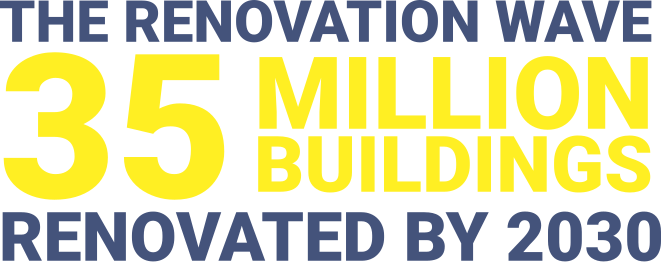
The so-called ‘Renovation Wave’ intends to renovate 35 million buildings by 2030, which requires at least doubling the annual rate of renovations in the EU.
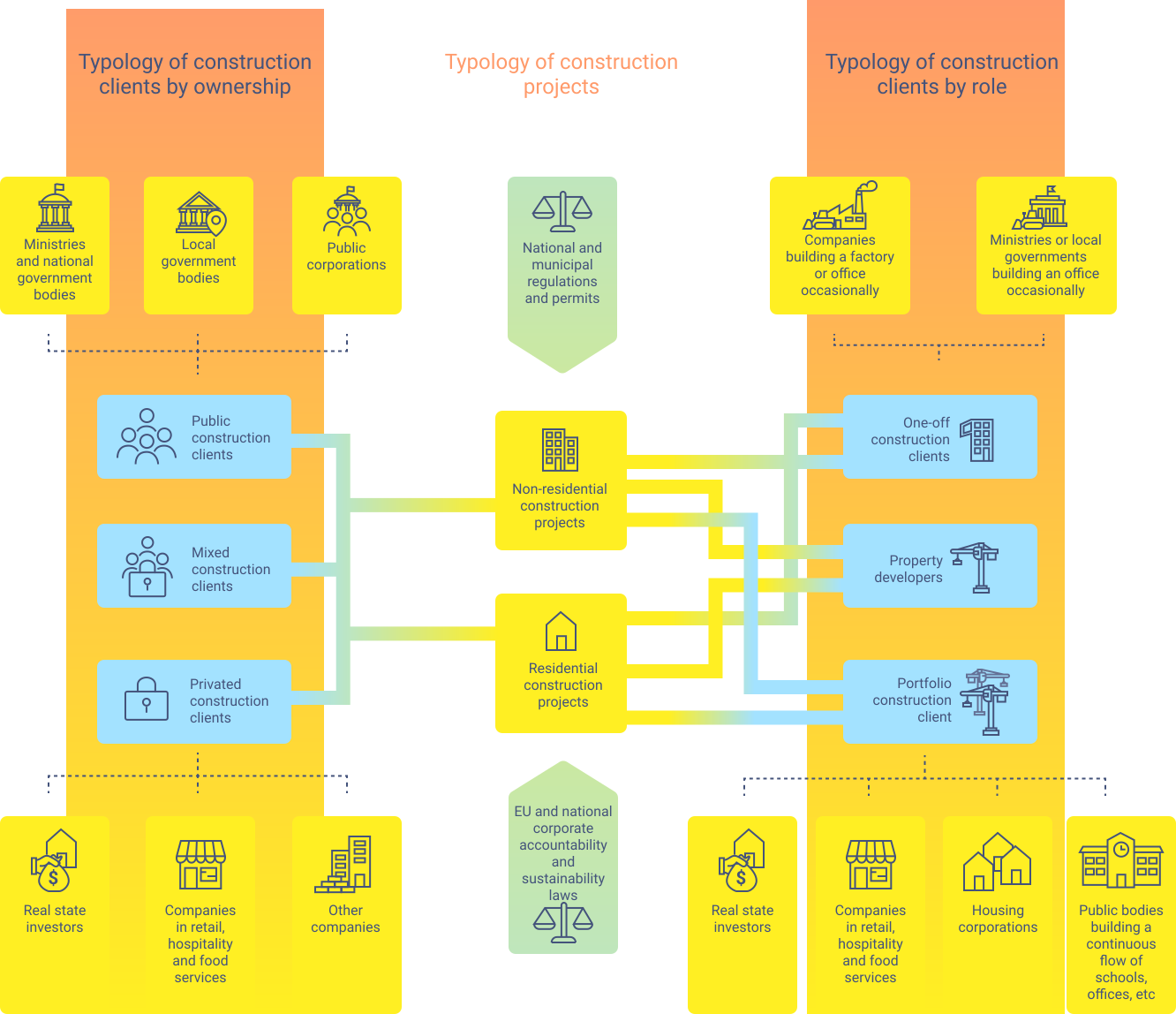
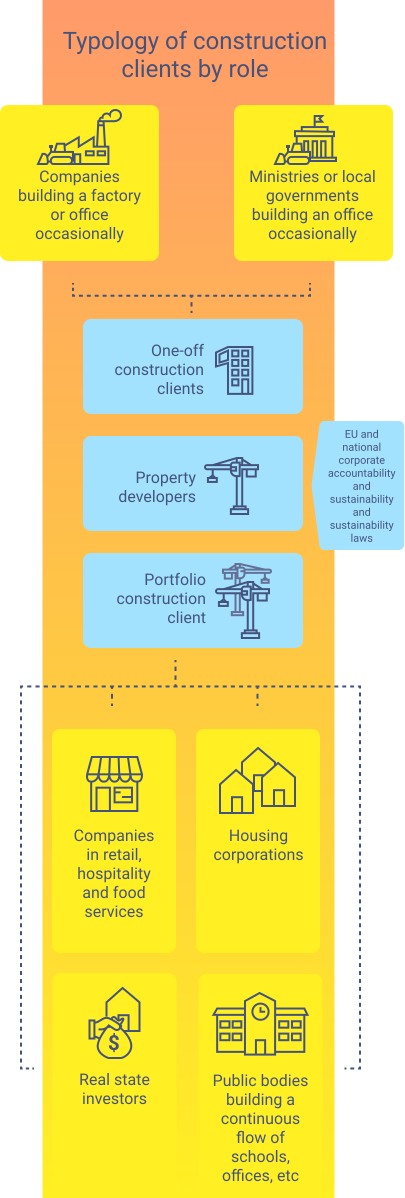
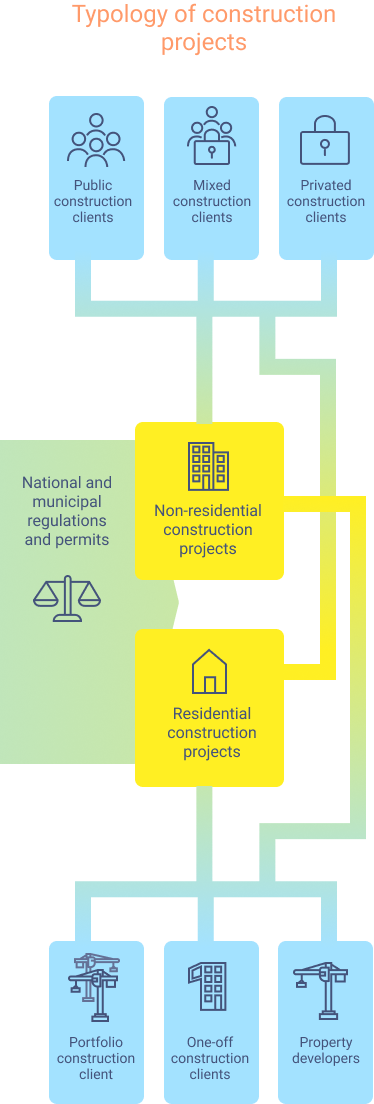
Typologies of construction clients, projects and public influences
Assessment of construction client policies
This analysis focuses on construction clients that own and manage a portfolio of residential and/or non-residential buildings and repeatedly appear as clients commissioning building projects, excluding one-off clients.
The responsible business conduct policies of the selected companies were assessed based on criteria linked to 5 themes:
Climate targets and reporting
Embodied GHG emissions and circularity
Operational energy and emissions
Social responsibility
Spatial planning